01
Identifying the growth
A salivary gland lump needs assessment to establish its cause. Examination, imaging, and tissue results help guide the discussion.
Super specialist · Oral oncology & microvascular reconstruction · Kolkata
Hindi · English · Bengali+91 89448 18464
Evaluation of salivary gland growths and cancers, with investigations and treatment guided by the diagnosis.

Salivary Gland Growth & Cancer
Evaluation of salivary gland growths and cancers, with investigations and treatment guided by the diagnosis.
01
A salivary gland lump needs assessment to establish its cause. Examination, imaging, and tissue results help guide the discussion.
02
The consultation brings together your examination, medical history, and any existing reports. Further investigations are discussed according to the findings.
03
Discuss the proposed treatment, alternatives, recovery, and follow-up with Dr. Saha. The plan is individual to your diagnosis and care needs.
About Salivary Gland Growth & Cancer
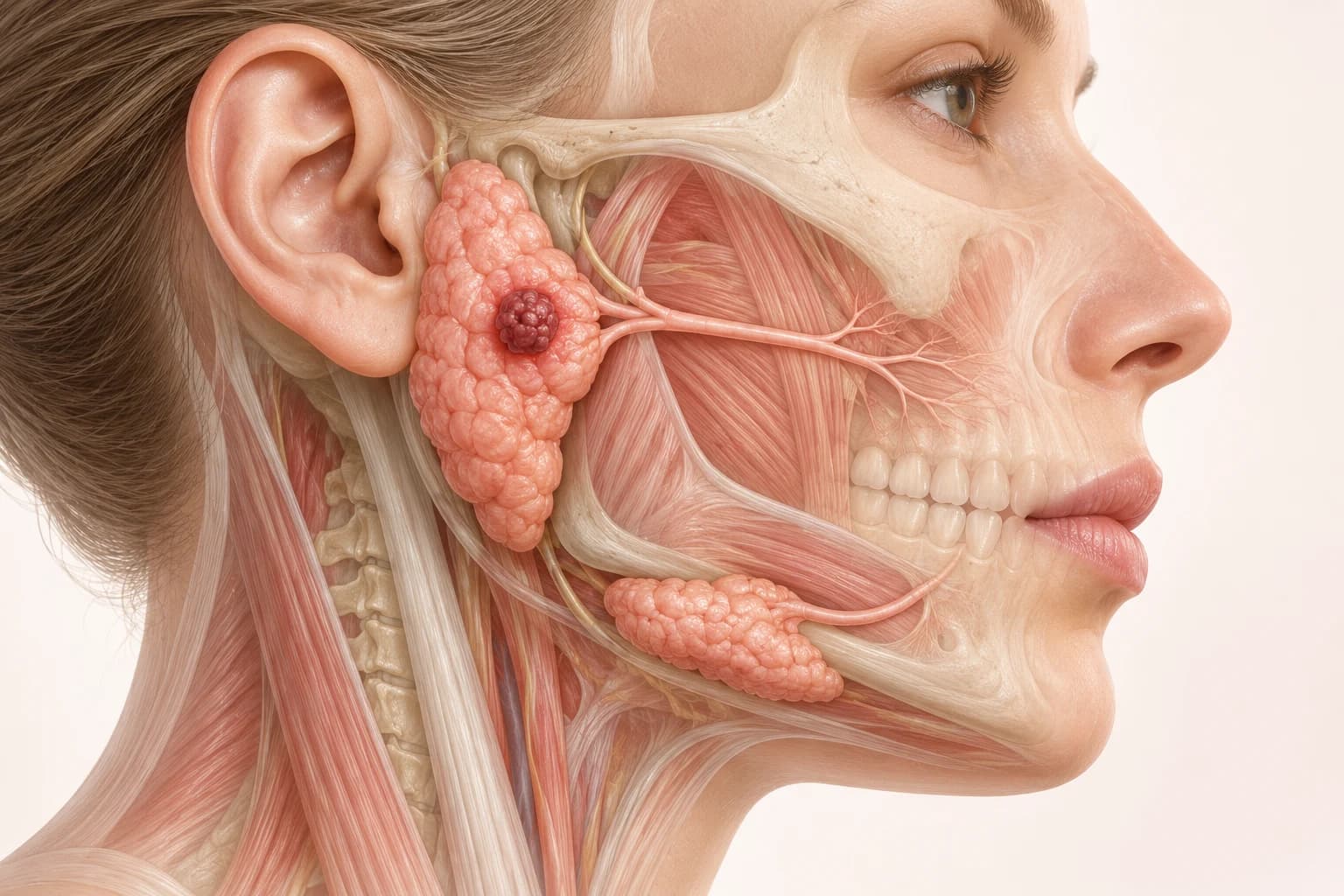
The main salivary glands sit in front of the ear (parotid), under the jaw (submandibular), and beneath the tongue. Many lumps in these glands are benign, but each still needs a diagnosis, because some benign growths keep enlarging and a smaller number are cancers.
An ultrasound or scan and a needle sample usually come first. If surgery is needed, nearby structures such as the facial nerve, which moves the muscles of the face, are identified and protected during the operation.
Related care

Surgical assessment and treatment planning for oral cancer, including discussion of reconstruction and continuing care.
Explore care

Specialist care for cancer of the tongue, with speech, swallowing, and reconstruction considered during planning.
Explore care

Assessment and surgical planning for cancer affecting the jaw, with attention to chewing and jaw reconstruction.
Explore care
Salivary Gland Growth & Cancer
Call, or send a request with what you have noticed. Family members are welcome in the room.